
How to create the perfect exhibition plan for event success
If you intend to exhibit in the next 4-6 months, you need to finalise your exhibition plan as soon as possible.
Luckily for your events team, we’ve already done the hard work and outlined what needs to be considered when planning an exhibition.
So, let’s get to it!

Exhibition stand planning essentials
When it comes to your exhibition plan, detail is everything.
And the details are even more critical if you intend to work with an exhibition stand designer like us.
So, here’s all the important information you need to put into your brief.
Your exhibition budget
First things first – your budget needs to be clear.
You’ll need to explain whether this budget is just for one event or whether you plan to attend several (and, if you’re attending more than one, how the budget will be split across the multiple events).
This will allow your stand contractor to suggest and design viable options for you, including stand hire.
Planning early also gives you more options.
If you’re out at shows regularly, it’s worth looking at the bigger picture rather than planning each event in isolation.
As a rough guide, if you’re exhibiting more than three times a year, buying your own stand structure can start to make sense.
If it’s one or two shows, a reconfigurable rental stand with custom elements often gives you the flexibility you need without committing to full ownership. Read our blog on how to maximise your exhibitions return on investment (ROI)

Planning your exhibition goals
It’s important to be clear on whether the exhibition itself supports what you’re trying to achieve.
Are you launching a new product? Looking to strengthen relationships with existing customers? Trying to get in front of a specific type of buyer?
The show you choose, and when it sits within your sales cycle, can influence the outcome.
Define what success looks like before you commit. That might include:
-
A target number of qualified leads
-
Pre-booked meetings
-
Product demonstrations delivered
-
Orders taken or products sold
-
Conversations with decision-makers
Make sure your team all agrees on the answers and that you’re clear on them, because this will be a crucial part of the planning process between you and your stand contractor and creates a stand that turns heads.
Clear objectives give your stand direction and make performance easier to review afterwards.

Marketing & promotion
Your exhibition presence should not begin on opening day.
Promote your attendance in advance through email campaigns, social media and direct invitations. Encourage prospects to book meetings ahead of time.
Consider how you will drive traffic to the stand before the event, not just during it.
When sales, marketing and stand design are planned together from the start, you create a more focused exhibition presence and stronger results.
Thinking about your exhibition stand requirements
Think about what functions your exhibition stand needs to perform. Do you:
-
Have any large products or props (for example, vehicles or machinery)?
-
Need an area for presentations?
-
Need a meeting room? If so, does it need to be a private, enclosed space?
-
Want a hospitality area?
-
Envisage a game or giveaway to attract visitors to your stand?
Make a list of your requirements so the finished product can tick them all off.
Once you’ve defined the practical requirements, think about how visitors will move through the space.
What will catch their attention first? Where will conversations take place? How will products or services be demonstrated?
A successful exhibition stand is not just built to fill space. It should guide visitors naturally and support your message. Clear branding and a logical layout help turn passing traffic into conversations.

Consider the rules of the exhibition venue you’re attending
Any stand contractor worth their salt will help you out with this bit, but it’s worth you being well-versed in the rules and regulations of the venue you plan to exhibit at.
Whether you’re heading to a venue in London, Birmingham, or another major city, each has pros and cons and accessibility considerations, and some of them (we’re looking at you, London Olympia) are just downright quirky.
Facilities like the NEC Birmingham and ExCeL London are amazing places to exhibit at, but they definitely require some preparation.
Take a look at our guides to the most popular exhibitions.
Consider different types of exhibition stand
Next, you need to think about what type of exhibition stand or booth is most suitable for your brand (and what fits in with the venue you’re attending!).
Exhibition stand designers like us will advise you on this, of course, but it always helps if you have a rough idea of what you need.
- A modular exhibition stand is an exhibition system comprising different blocks that can be reconfigured to fit various spaces.
- Shell schemes are pre-assigned spaces allocated to you by exhibition organisers. They’re booths, usually with 2-3 walls, that can be customised with your choice of graphics, furniture and props.
- Bespoke exhibition stands are purpose-built for each exhibition.
- They’re unique to your business and the event you’re attending.
- A space-only exhibition stand is an allocated plot of exhibition space. All you get is the floorspace – the rest is up to you (and us!).
You also need to consider whether you want to rent or purchase your stand (and what goes on it!).
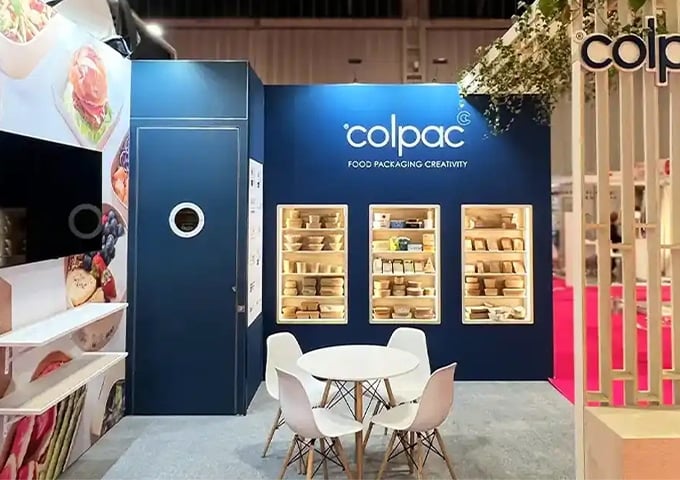
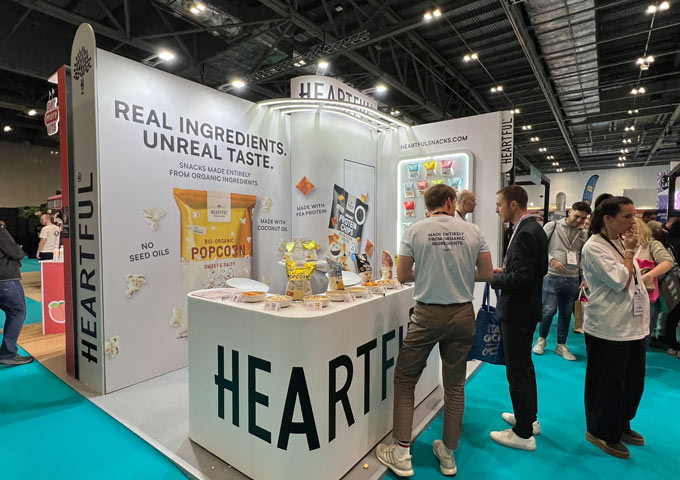
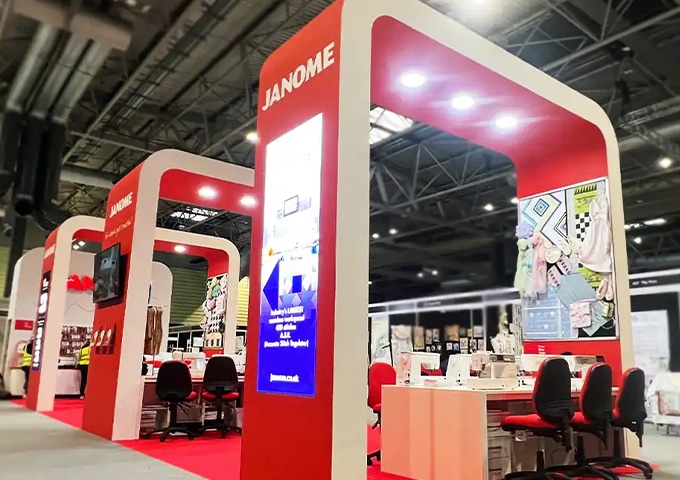
A stand can be owned entirely, rented, or a combination of the two. Combining owned and hired elements is great for maximising the space you have or adapting a pre-existing stand to accommodate unique features for a specific event. We’ve added loads of interactive hired elements to stands we’ve built, including seating areas, demo areas, presentation areas, games, and even a fully functioning kitchen!


“If you think you can only hire a couple of bits of naff furniture from us, then think again.
“We supply anything and everything you can think of for hire: giant video walls, games, furniture, touchscreens, stylish future and even the structural elements to cleverly design your stand in an impactful yet cost-effective way.”
Ed Marshall, Creative Director, Motive Exhibitions

Think about a sustainable exhibition plan
Is sustainability and sustainable exhibiting important to your brand?
If so, you need to consider how you’re going to incorporate this into your exhibition plan.
The exhibition industry is not known for its eco-friendliness. But it doesn’t need to be this way, and there are plenty of ways to make your exhibition presence as eco-friendly as possible.

If you plan to exhibit more than three times in one year, we’d recommend buying your stand.
“Using the same stand multiple times allows you to be smarter with your planning, and we can create a design that can be repurposed and reconfigured for each event you attend. We’ll add clever little touches and adapt the existing stand to suit any exhibition space you book.
“By doing this, you can significantly reduce the cost of every exhibition, as well as your environmental impact”
Dave Hennessy, Director, Motive Exhibitions

Prioritise your exhibition stand over your space
When it comes to exhibition budgets, we see this happening time and time again.
Businesses book the biggest floor space they can without thinking about the design. They’ve secured a massive space, but there’s no money left to buy anything to fill it!
It’s not worth spending 90% of your budget on your space and leaving yourself with hardly any options on what you can do with your stand. Even the scales out; budget for a smaller stand which looks great, rather than going big on floor space for the sake of it.
We can advise you on what budget you should allow for what you are trying to create, and make sure that you have an awesome-looking stand which is the perfect size. Take a look at the trade show trends we expect to see this year.
Plan your exhibition resources
If you’re a small team, then taking 3–4 members of staff away from the office may not be an option.
So, you might have to consider hiring contractors who are experienced in working on exhibition stands, even if it’s just for the hospitality side of things.
Or, you can consider a rota whereby your own team mans the stand for a day or two at a time — but don’t leave yourself short as there’s nothing worse than having an exhibition stand full of visitors that you can’t chat to.
It’s also worth deciding in advance how you’re going to capture leads.
Will you use the organiser’s badge scanner, a lead capture app or your own digital forms? Whatever you choose, test it before the show and make sure your team knows how it works.
Your staff should understand the objectives of the event, the key messages and how to qualify leads properly. A good stand helps — but it’s the people on it who make the difference. Read up on our top tips to choosing the right exhibition stand staff.
PS: Don’t forget to budget for accommodation for staff and contractors!

Post-event communications
Your event was a success! You’ve met some great prospects, exchanged details and feel optimistic about your new leads.
Time to put your feet up?
Not so quick…
Your exhibition plan also needs to include your post-event communications, which should be completed and ready to go before the exhibition starts.
Whether this is emails, brochures, flyers or even product samples, your follow-up should support the objectives you set at the start of your plan.
Every hour counts after an exhibition, so strike while the iron is hot.
Think beyond a single follow-up email.
Connect on LinkedIn, share social content, publish a round-up blog or offer useful follow-on content such as whitepapers or demo sessions to keep conversations moving.
If visitors purchased your products, use post-show communication as an opportunity to gather feedback and build on those relationships.
It’s also worth creating content that answers the questions prospects may continue searching for after the event, and looking at any post-show PR opportunities.
After the event, review your performance.
How many leads were generated? How many were qualified? If you were selling products, how many were sold — and is there an opportunity to generate further sales from the same audience?
What worked well? What would you approach differently next time?
Reviewing results helps you refine your approach and improve performance at future exhibitions.
And finally; have a ‘plan B’ in case of bad weather!
Fingers crossed it won’t snow, but the Great British weather is unpredictable in autumn and winter, so make sure you’ve got a plan A and a plan B for how your staff are getting to the exhibition, and how they’re getting to and from the venue each day if they’re staying over.
It’s also worth considering booking transport and accommodation for important visitors – especially if they’ve travelled a long way to see you.
“Whether you’re travelling to a one-day event or going backwards and forwards between the venue for a several-day exhibition, give yourself more travel time than you think you’ll need.
“It’s much better to be somewhere earlier than needed, than running the timings to the wire and arriving stressed because the weather didn’t work in your favour.”
Sam Hudson, Operations Director, Motive
We’d love to hear from you
Simply fill in the below, and we will be in touch
Motive Exhibitions, 3 Orion Court, Ambuscade Road, Colmworth Business Park, Eaton Socon, St. Neots, PE19 8YX